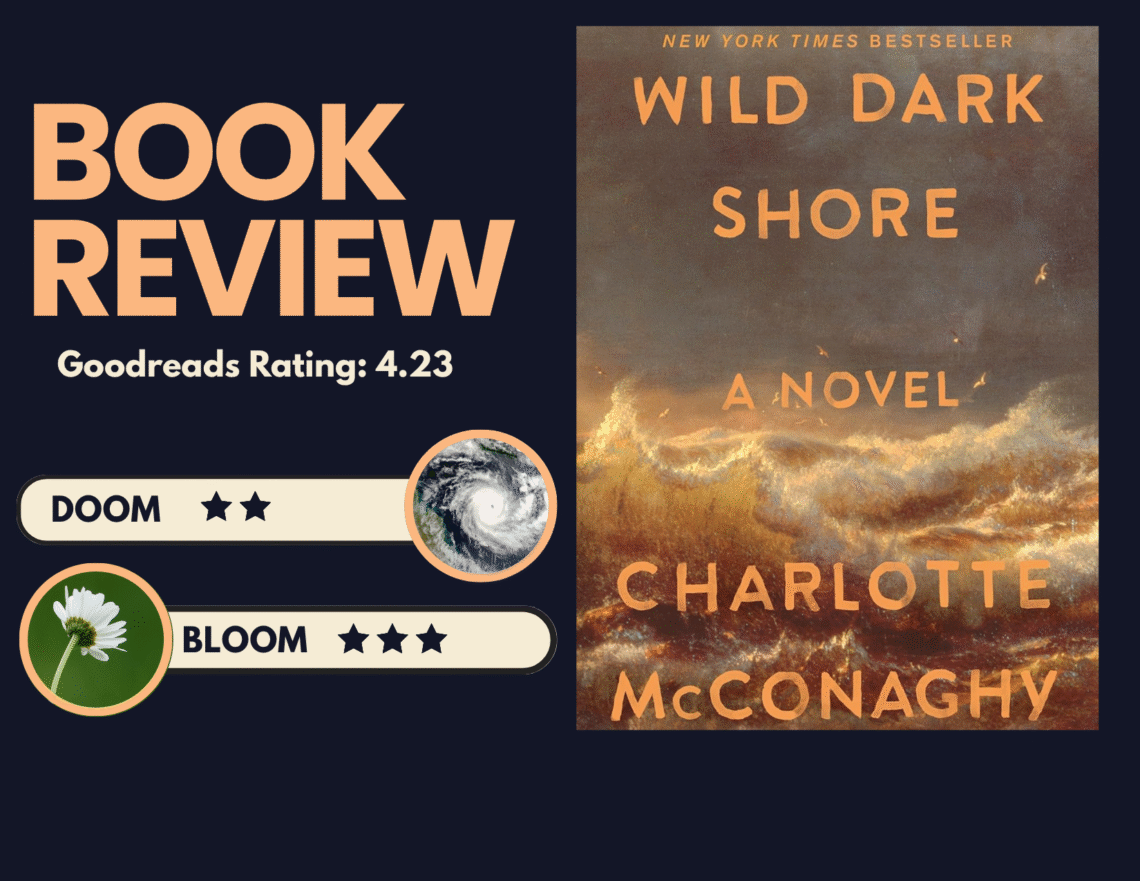

This climate fiction book review analyzes the best-selling novel Wild Dark Shore, where climate impacts form the catalyst for the action-packed plot. Wild Dark Shore tells the story of an isolated family living on the world’s largest seed bank in the Southern Ocean who collides with an unknown woman who washes ashore.
Why Climate Fiction?
While the world succumbs to droughts, fires, and rising seas, a father and his three children live on Shearwater Island, a sliver of land in the middle of the Southern Ocean that is nearly uninhabitable to humans due to its frigid temperatures and wild weather. Shearwater Island’s harsh conditions make it perfect for preserving the world’s largest seed bank, stored in a tunnel beneath the permafrost. That is, until the permafrost begins to thaw, the seas rise, and a violent storm knocks out the island’s power supply that keeps the vault at optimal temperatures. The storm also sends an unknown woman ashore who forces the family to reckon with their haunted past, while they rapidly prepare to relocate the seeds and leave the island.
This multiple-POV story intertwines plant science, biodiversity needs, and climate anxiety with a fast-paced mystery that had me rooting for each main character, even when they were working against each other.
“One day soon enough, everything is either going to burn, drown, or starve, including us.” – Rowan
Wild Dark Shore: Doom or Bloom?
This story is equally doom and bloom. In a near-future timeframe, climate change is causing widespread flooding, famine, and fire, which impacts the main characters at various degrees. Characters discuss whether it’s appropriate to have children given the global circumstances. Dom is terrified of a parent’s inability to keep their children safe. Rowan is sad and fearful of the world’s future, feeling powerless to make meaningful change.
Yet, this isn’t a dystopian novel. Governments still function, and the characters are mission-driven, trying to preserve the seeds. Rowan bonds with the Salt family and finds purpose, despite efforts to keep a distance. Dom maintains a stoic optimism in living on the island, fixing things “because someone has to, or everything just stays broken.”
Seed Lessons from a Boy

One of my favorite characters is nine-year-old Orly, a precocious child and erudite botany scholar. Throughout the novel, he teaches his family and Rowan about the amazing resilience that plants show.
- A daffodil is a survivor that can grow anywhere, a ‘blowball’ that can float 100 kilometers.
- A buzzy burr clings onto animals and can circle the globe.
- Mangrove seeds float until they find their perfect home, assessing the water conditions.
- Wollemi pines, the ‘dinosaur tree,’ have survived by staying hidden from humans, located in rugged terrain.
- The banksia plant emerges from wildfire ash, as it requires that extreme heat to germinate.
- Kelp forests survive underwater, completely submerged.
Orly celebrates flora and fauna for their adaptability and value beyond what they offer directly to humans. In current times, this message resonates deeply with me.
Climate Fact or Fiction?
Wild Dark Shore is a mystery thriller set on a fictional Shearwood Island based on the real Macquarie Island and the Svalbard Global Seed Vault. The Svalbard Global Seed Vault protects over 1.3M seeds as a global backup food supply!
Wild Dark Shore feels like the near future because there aren’t clues about new technology advances. However, rising seas are significant enough to flood the island and cause them to relocate. I would guess that this must be at least two or three feet to make such an impact. NASA’s sea level rise viewer predicts .78 meters of sea level rise by 2100 using modeling data, though, as the saying goes, “all models are wrong; some are useful.” Actual sea level rise might not be such a gentle slope. If a large enough ice sheet breaks off or something drastic happens, we could see more sea level rise. So, it’s plausible that Shearwood Island is experiencing substantial flooding. Climate impacts will include wildfires and droughts, which can challenge food systems.
I didn’t question the science as much as why the United Nations and the Tasmanian Parks and Wildlife would allow six weeks to pass without contact. This is much too lax protocol for maintaining communication with such a precious resource like a global seed bank! If they knew the island conditions were deteriorating, wouldn’t they check in with the island more than once every couple of months? On the other hand, maybe the world is so chaotic that no news is good news. What did you think?
Closing Thoughts
Wild Dark Shore has its fair share of tragedy, violence, and suffering. Yet, it’s mostly about a family’s resilience and the efforts they’ll take to protect what they love. Thank you for reading this book review of Wild Dark Shore!
Learn More
- Learn about Macquarie Island, a UNESCO World Heritage Site.
- Learn more about the Svalgbard Global Seed Vault! Located in Norway, you can take a virtual tour here.
- View the Wollemi Pine (the “dinosaur tree”) here.
Do More
- Biodiversity is critical for planet health! And climate impacts are straining wildlife! Read more from the World Wildlife Fund about climate change and nature here.
- Locally, you can support your native wildlife with native plants to provide food and habitat for animals. Connect with your local library or native plant society to learn how to help.