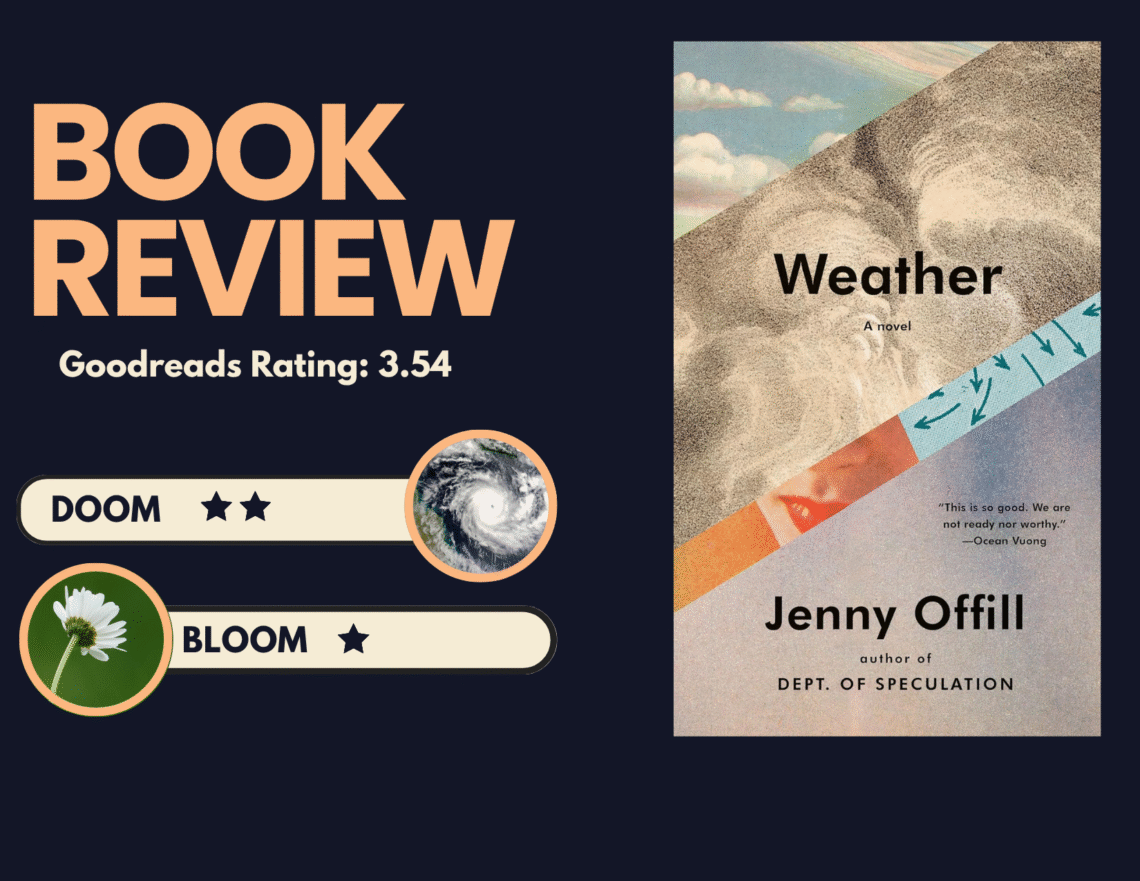
This climate fiction book review profiles Jenny Offill’s Weather, a 224-page novel that follows the main character, Lizzie, going through her daily minutiae. She works at a library. People overshare their problems with her. In fragmented, New York City scenes, Lizzie bumps into distressed family members, neighbors, and pseudo-strangers, all of whom need something from her. Sometimes it’s her child wanting snacks or her brother needing help managing his addiction. Other times, it’s the random stoop person who every New Yorker befriends at some point in their city residency needing a fake therapy session.
Lizzie lets herself be the venting receptacle for the most part, only veering away from the occasional awkward situation, such as avoiding her son’s friend’s mom on the street. She fluctuates between worrying about minor issues (e.g., what’s wrong with my knee?) and more existential questions (e.g., young people worry that nothing they do matters while old people worry that everything they do does). Her former professor, now a climate change podcaster, hires Lizzie to answer fan mail. At first, Lizzie answers the mail without much regard for the content. By the end of the novel, the fanmail angst of climate change doom starts to penetrate Lizzie’s psyche as well. She starts imagining a climate exit strategy for her and her family that includes a “doomstead.”
Do you really think you can protect [your family]? In 2047? … Then become rich, very, very rich. – Sylvia
Cli-Fi Gloomy Weather
I read Jenny Offill’s Weather on an e-reader, counting down from 5% remaining, to 4%, and so on, thinking, “Wait, how will this story be resolved?” At first, I was annoyed after finishing Weather. I thought, “Here’s a book I’ll never think about again. Did anything actually happen? It was one random flood of thought after another!” Exasperated, I turned off my e-reader with a sigh. Would I even write a climate book review of Weather? This story didn’t change me one bit! So I thought.
Yet, the next day, I was scrolling through my phone’s news feed (okay, fine, Instagram) while sitting in bed and not doing anything about the issues I was reading about. With a jolt, I realized Weather’s brilliance. Each day, the news throws climate change headlines our way: Melting glaciers, horrible biodiversity loss, island communities having to contemplate relocating. The angst of wondering if it’s humanity’s inability or unwillingness to act that will make widespread global climate change all but inevitable. A complete love of and joy for the planet and total sorrow for what might be lost. It’s absolutely overwhelming and crushing to hold all these feelings in our brains each day. So, the barrage of doomsday fragments has conditioned our brains to think, “Yep, so what? Nothing to be done,” and we move on to the next thing occupying our daily lives: Grocery lists, birthday gifts, annoying co-workers.
Enter Lizzie, a typical middle-class American who is chronically stressed about climate change, but unable to do anything about it. Other than dreaming about her “doomstead” with her husband, that is. Meanwhile, the daily responsibilities of being a parent, a spouse, a friend, a sister, an employee, a customer, etc., fill most of her time. In Weather, climate change is an ancillary, albeit massive, problem that is still abstract. Somewhere over there, something “other.” Something that can’t be tackled collectively, if at all. Even Lizzie’s boss, a career climate expert, gives up and moves away, only wanting someplace quiet.

Don’t Let Climate News Get You Down!
Weather is a clever example of why climate communicators tell policymakers and scientists to quit with the “doom-and-gloom” headlines. Researchers have found that although “doom and gloom” messaging can motivate people to talk about climate change, it can also “induce helplessness, discouraging individual-level action.” We don’t want that! Yes, we need science and data, but we can’t dump bad news on people without actionable steps to get to a desired goal. A barrage of bad news might entertain us in the “car wreck” type of way as we watch the ice sheets melting, but it won’t compel us to lower our carbon footprint. The next day, we’ll remain unchanged.
Reading Weather is a bit like doom-scrolling, which is why I thought the story wouldn’t stay with me. Its scenes are like 30-second reels, providing a quick dopamine fix before being supplanted by the next image of cute rabbits or angry neighbors demonstrating their entitled outrage. Perhaps that’s Offil’s point.
Thank you for reading my climate fiction book review of Weather!
Learn More
- Climate change is happening. And without unified, serious action throughout the world, we are going to see a lot more death and destruction. See The Guardian’s coverage of the 2023 Intergovernmental Panel on Climate Change here. And check out the climate science resources here for learning about potential impacts.
- It’s not too late to limit some of the worst effects, according to NASA. We can’t give up now!
- Did you hear the term “doomstead” before reading Weather? I had not, and I couldn’t find much more in researching for this blog post. But, The Guardian talks about the liberal prepper movement here.
Do More
- Don’t let climate anxiety paralyze you from acting! See Dr. Ayana Elizabeth Johnson’s Venn Diagram for thinking about how you specifically can do something to help climate change.
- Check out the Climate Mental Health Network website for tips and resources on managing stress.