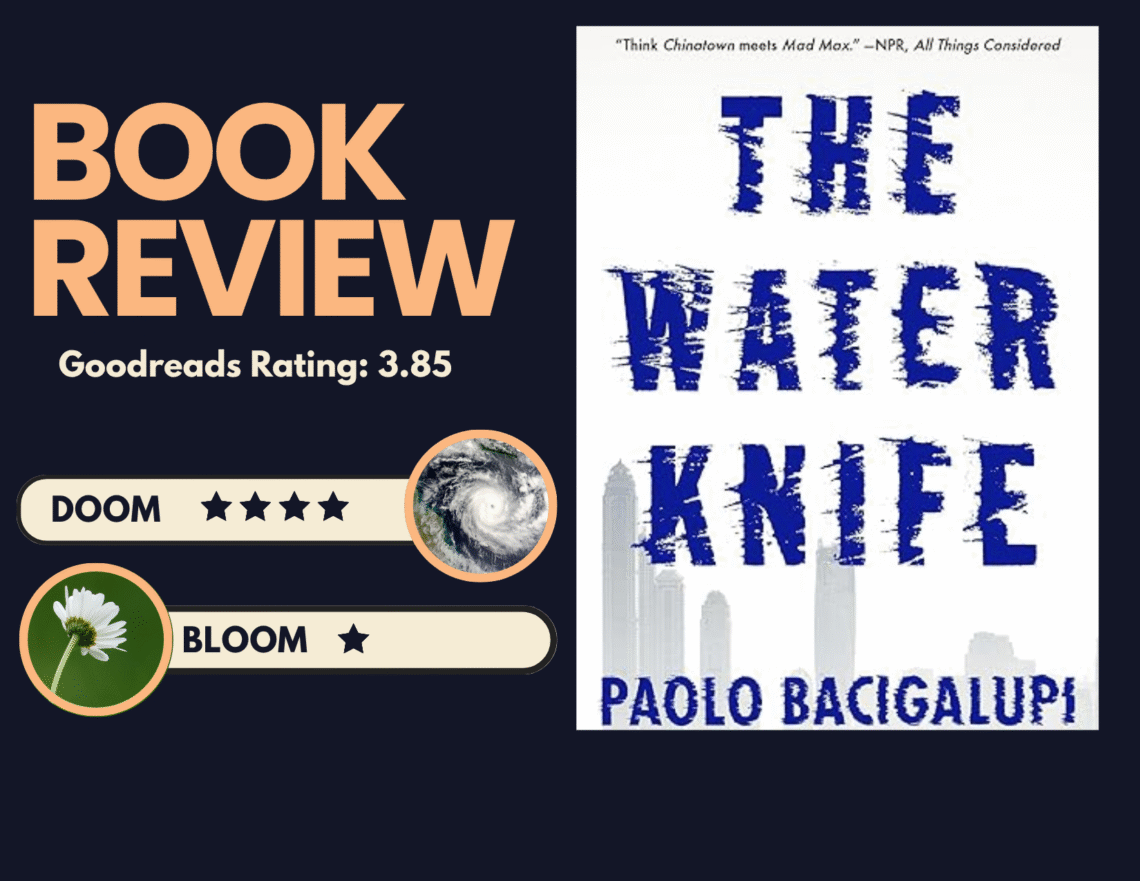

Is The Water Knife climate fiction? Certainly! In a future world where climate change has led to widespread droughts with unforgivable dust storms, corrupt governments fight to control water rights and keep refugees in their place. Read this if you are looking for a fast-paced dystopian thriller that shows how water scarcity could impact our humanity.
Trigger Warnings: violence, torture
Why is The Water Knife Climate Fiction?
In The Water Knife, generations have ignored myriad warnings about climate impacts and overconsumption as they continued to build in the Southwest United States. Nevada and California are powerful with militia and spies, able to cut off water supply at their will. Those who own the water rule the land. Their neighbors from Arizona and Texas are desperate, each looking for an angle or advantage that will get them north.
People often criticize the environmental movement as being only for the elite who can afford solar panels and electric vehicles. In The Water Knife, we see this theme played out to the extreme. Only the rich and well-connected live in comfort and reap the benefits of clean energy, recycled water, and urban gardens in utopian Arcology towers. The have-nots are scrapping by, drinking their own filtered urine and stealing scraps when they can.
Then, people hear rumors about long-lost water rights that could shift the power balance. This leads to a ‘water knife,’ a journalist, and a Texan getting entangled in a murder mystery.
For a full summary, SFF World’s excellent review is here.
“If I could put my finger on the moment we genuinely f$cked ourselves, it was the moment we decided that data was something you could use words like believe or disbelieve around.”
Cli-Fi Doom: Violent Scenes and Powerless People
Perhaps if I had the copy with the tagline, “When the water runs out, blood will flow,” I would have known that there was so much violence in the novel. Even though I’m a squeamish reader, I got through the murders, body disfigurements, and torture scenes because they were done well and essential to the narrative. Plus, the action-packed plot and believable world-building kept me entertained. (Though I’ll never look at hyenas the same way.)

In the novel, people are desperate and selfish. They have to be, or they’ll die. Class warfare is at an extreme, and perhaps it’s because I assume I’d wind up as a “have-not” that I’m even more anxious about this future than if I was an elite one-percenter in modern times. In Phoenix where things are really bad, sensational journalism of latest murders abounds, with trending hashtags like #BetterThemThanUs. “Blood rags” show grisly images of murders while people play the lottery for how many people turned up dead that week.
Two of the three main characters are survivors who realize that morals and humanity aren’t relevant anymore. Angel, a water knife, tells Lucy that people are all the same, quoting the famous Stanford Prison Experiment that showed how “ordinary college students could do terrible things.” Depending on the circumstance and your own luck, you’ll either be the prisoner or the guard. You are either turning off the water or dying from dehydration. Maria, a young woman determined to escape her circumstances, agrees with Angel. She criticizes Lucy because “[s]he thinks the world is supposed to be one way, but it’s not.” Lucy is still thinking about how to get back to the past. But too much has changed to ever go back. According to Maria, Lucy’s “old eyes” are a weakness.
Cli-Fi Bloom: Slivers of Humanity
On the hopeful side, some people show kindness and look out for one another. Lucy is a Pulitzer Prize-winning journalist who sacrifices her safety to report on the atrocities imposed on Phoenix residents, obsessed with finding out the truth from an unspeakable crime. As a counterpoint to Angel and Maria, Lucy maintains a sliver of optimism and fights for her neighbors until the end. Toomie is another character whose humanity shines, as he tries to help Maria. Yet, Lucy and Toomie are in the minority here, outweighed by pragmatic assassins and murderous corporations.
Climate Fact or Fiction?
In the Southwest, climate change has already caused increased heat, drought, water scarcity, and heat-related health impacts. If we maintain current levels of greenhouse gas emissions, scientists predict that this will get even worse. Bacigalupi presents a well-researched and believable future of what is indeed possible.
My dubious radar went off when I kept reading about people drinking urine filtered by ClearSacs. But did you know that urine is up to 96% water? You’re welcome! From a political science standpoint, would the federal government let states run amok with controlling the water supply and killing people? Let me know if you agree or disagree in the comments!
Closing Thoughts
The Water Knife is a cautionary tale about what could happen when humanity fails to work together for the common good. Although some main characters achieve their goals, the world doesn’t change. The rich and powerful make self-centered decisions that preserve their power, and the destitute continue to die. Generations before them had every chance to make different decisions to avoid the widespread environmental challenges, but they couldn’t help themselves. For our real world’s sake, I hope we do better.
I do love that in this future, REI now sells dust masks along with other survival equipment. Do you think Lucy is getting those Member Rewards points?

Learn More
- California is the largest user of the seven states with water rights to the Colorado River. The river “has faced persistent drought since 2000” and challenges from overconsumption.
- A 1922 Compact governs “the equitable division and apportionment of the use of the waters of the Colorado River System.”
- Published in 1993, Cadillac Desert is a book about the West’s water challenges and plays a prominent role in The Water Knife. See more details about it here.
Do More
- You probably remember from middle school that most of the world’s surface is made of water. But did you know only 1% of the water on Earth is ready for human consumption? Evaluate your water footprint at home and conserve where possible.
- Conserve at Home. Easy ways to conserve water at home include all the simple things you are probably annoyed at having to read right now: repairing leaky toilets, shutting off the faucet when not using it, taking showers instead of baths, etc. Do what you can, and remember that a small step is better than nothing. See tips from the EPA here.