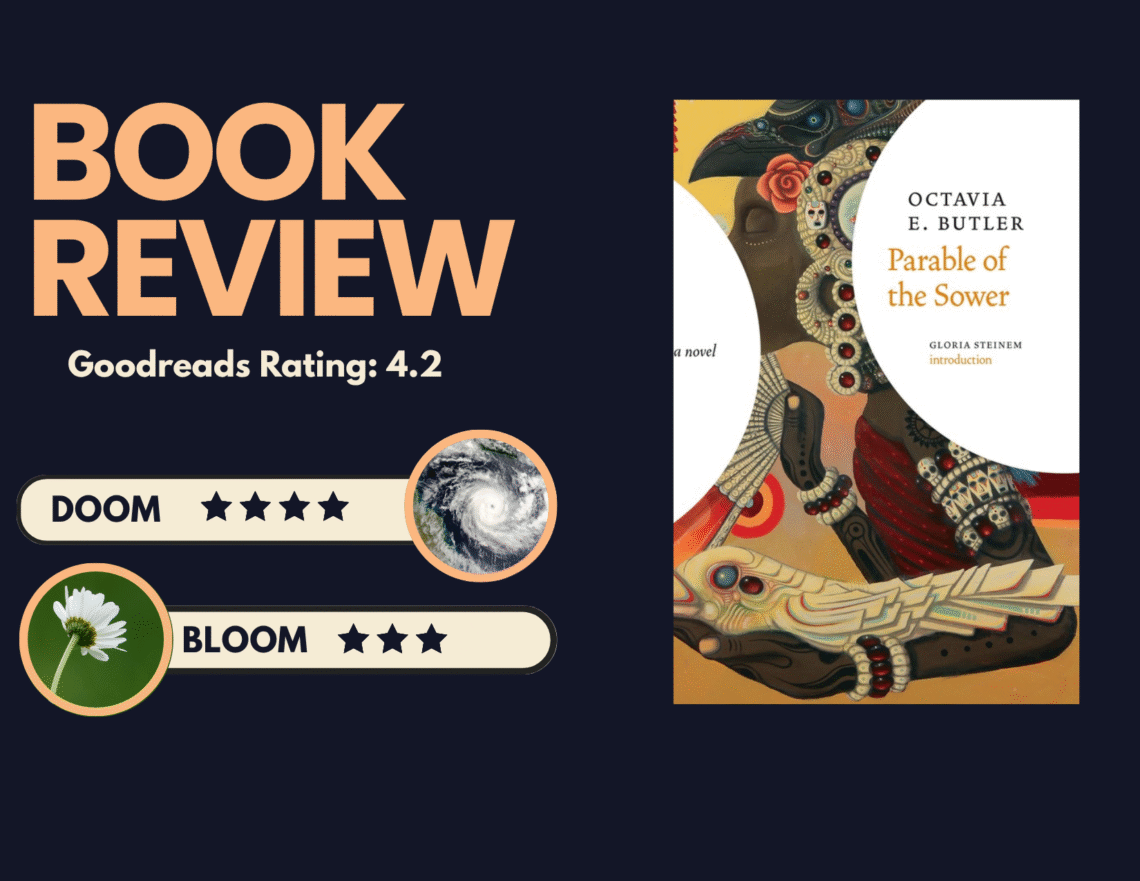
This review of legendary Octavia Butler’s Parable of the Sower covers one of the cli-fi classics. Written in 1993, Parable of the Sower is a must-read novel for anyone interested in the emerging climate fiction genre. Butler was clearly ahead of her time, writing a dystopian novel that takes place in Southern California in 2024, where climate change has led to scarce resources, chronic droughts, wildfires, and near social collapse. There are elections, governments, law enforcement, and markets, but most people are generally left to fend for themselves. Protagonist Lauren lives inside a compound with her family and a handful of neighbors, though she predicts that the walls won’t keep them safe forever.
The Destiny of Earthseed
Is to take root among the stars.
Trigger warning: violence and sexual assault
Classic Dystopia
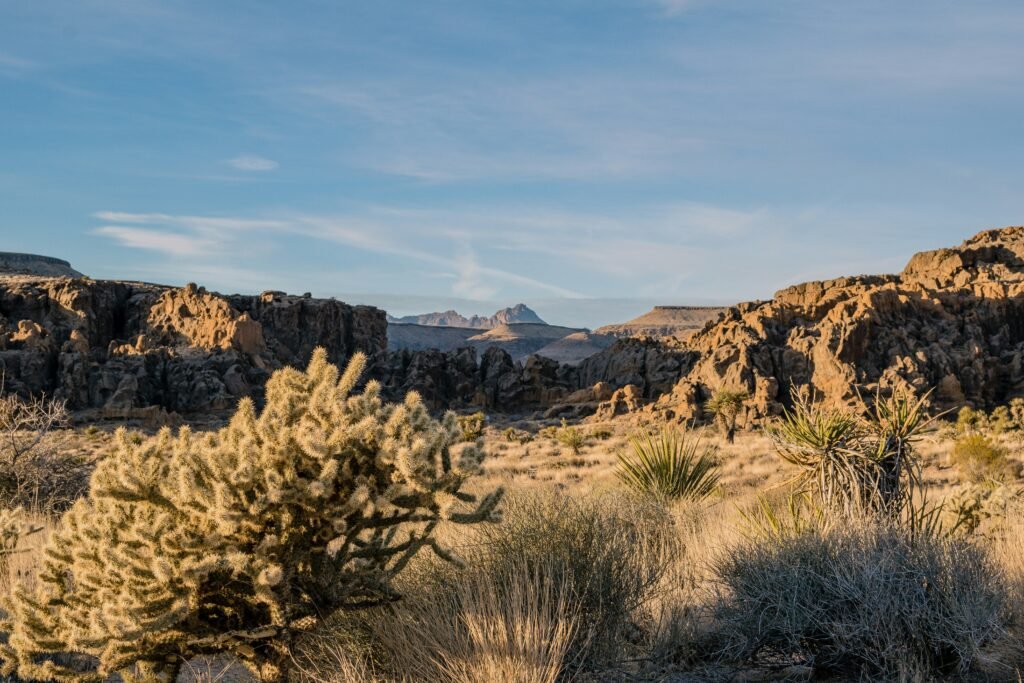
Lauren’s situation is bleak. She lives inside a compound, but she and her neighbors risk their lives every time they leave their walls to run errands that include shopping and target practice. It hasn’t rained for six years in Lauren’s neighborhood. Food is scarce. Lauren suffers from hyperempathy, where seeing other people’s physical pain means she feels it too. It’s a horrible weakness to have when there’s so much violence surrounding her. Children and adults are raped and murdered without fanfare or police interest.
Although Lauren feels other people’s physical pain, her interiority describing the gruesome scenes is almost scientific, objective. She is horrified by what she sees, but she describes the torture and violence with detachment. She never breaks down from other people’s emotional pain. Perhaps she’s learned to detach from the emotional connection lest it kill her.
Lauren’s walled neighborhood allows its residents to be overconfident in their safety. Conditions are even worse for those living outside the protected boundaries of a neighborhood. “Crazy to live without a wall to protect you,” Lauren says. “[M]ost of the street poor—squatters, winos, junkies, homeless people in general—are dangerous.” It’s like The Hunger Games without the games and rewards.
All that you touch You Change. All that you Change Changes you. The only lasting truth Is Change.
Earthseed Dreams
From the beginning of the plot, we see Lauren documenting her thoughts about “Earthseed,” a religion that she identifies through “discovery rather than invention, exploration rather than creation.” The core tenet is change. She keeps her thoughts private until she believes that her community is in impending danger. Lauren tries to warn her neighbors that those outside of the walls will eventually find a way in, but her neighbors ignore her. They would rather live in ignorance than learn survival skills. The neighbors don’t want to change the status quo or think about impending doom when, for the moment, they are sheltered and fed.
Lauren’s father scolds her for being too blunt with the community, though he sees value in what she proposes. He advises her to be cautious with the neighbors. Instead of telling them to pack a go-bag for rioters, for example, he tells Lauren that they will encourage the community to pack a bag in case there’s an earthquake. He agrees to help Lauren increase security in the compound with neighborhood watch groups and self-defense training.
In order to rise
From its own ashes
A Phoenix
First
Must
Burn.
Without revealing too much, suffice it to say Lauren must flee her home with a couple of other companions and head north. Rumors are that the north has affordable water and possibly work. Along the way, they find allies. Lauren is pragmatic, telling her group that five is better than three. Eight is better than six. They become stronger as a group, able to fight off scavengers who challenge—and sometimes attack—them as they travel by foot. They, too, have to scavenge for food and water.
Climate Fiction: Doom or Bloom?
Parable of the Sower shows how quickly a world can unravel. In just three decades, climate change and social collapse have led to a dystopian world where people struggle to survive each day. The super-rich avoid any discomfort, and ordinary people like Lauren have lost faith in the federal government looking out for them. Yet, Parable of the Sower’s dread and horror are countered by Lauren’s pragmatic optimism that she must push forward and find something better. She leads her friends to safety, protects children, forms alliances, and teaches her group to be relentless in their resilience.
I finished this book in about three days and never felt overwhelmed by the atrocities, even though I can be squeamish. This is because I was rooting for Lauren and wanted to see how she’d fare.
Climate Fact or Fiction
Scientists agree that climate change can lead to widespread droughts like those occurring in Lauren’s fictitious California neighborhood near Los Angeles. California “megadroughts” have occurred that have lasted for decades. However, something incredibly dramatic would have had to occur to cause a six-year gap in rain within just thirty years from when Butler wrote the story. Again, I’m not a climate scientist, just a climate policy leader, but this stuck out to me as extreme.
Also, could these characters have enough food and water to sustain themselves in their neighborhood compound when it hasn’t rained in six years? Why would Lauren’s family be growing carrots and leafy greens? Shouldn’t they be planting calorically-dense food like beans, yucca, and potatoes? Maybe I don’t understand drought-tolerant plants in California weather.
Parable of the Sower Book Review: Closing Thoughts
It’s scary that Butler published Parable of the Sower in 1993, and the book begins in 2024. In just over 30 years, Butler presents a world where society collapses and the United States becomes a grim landscape of desolate people. Lauren’s neighbors are in denial of the looming threat.
This is similar to how people perceive climate change impacts now. Currently, the world is fine, on average. We haven’t lost all coral reefs. Not all of the glaciers have melted. So, we can continue on, thinking that the looming threat maybe isn’t so bad. It’s a self-preservation instinct to avoid thinking about the future when it causes distress and discomfort.
Yet, Octavia Butler shows us that you have to face uncomfortable challenges head on. Her character Lauren would say we can’t be afraid of change, and if the climate is changing, we must address it. We must gather supplies, we must adapt. And while we do this, we need to do so with community. Self-interest and inability to adapt will lead to one’s death. People who work together fare better than those who go it alone. People won’t survive without community in Butler’s world. And isn’t that the truth for ours as well?
Civilization is to groups what intelligence is to individuals. It is a means of combining the intelligence of many to achieve ongoing group adaptation.
I hope you enjoyed this climate fiction book review of Parable of the Sower.
Learn More
- Wildfires are a natural process, according to the California Air Resources Board.
- Yet, climate change is likely increasing wildfires beyond what humans are used to. With the January 2025 Los Angeles wildfires, for example, human-caused climate change was “likely” a factor.
- Octavia Butler was a science fiction writer whose death took the literary world by surprise. Learn more about her here.
- Parable of the Talents is the follow-up novel to Parable of the Sower. Learn about the series here!

Do More
Lauren isn’t wrong about having an emergency kit. Not for the collapse of society, necessarily, but in case of an actual earthquake, wildfire, hurricane, or other disaster that could take you away from your home. See Ready.gov’s website for tips on building an emergency kit.